

In high-end catering, airline services, hotel dining, and branded dining services, every detail of the dining experience conveys brand information. The quality of food, plate presentation, packaging design—and increasingly important—cutlery provided with meals. For brands that have already invested in sustainable sourcing, high-end service design, and differentiation in customer experience, using ordinary disposable plastic cutlery at this critical touchpoint in dining at best misses the opportunity for brand expression, and at worst creates a contradiction between brand promises and actual experience.
Corn starch cutlery provides a way to resolve this contradiction for brands. As a biobased disposable cutlery material, corn starch cutlery can be molded into custom colors, embossed with brand logos, designed with ergonomic handles, and packaged into branded cutlery sets. It transforms what was once purely functional cutlery into a visible expression of brand sustainability commitment and service quality. For airlines, hotels, event caterers, food delivery platforms, and high-end takeaway brands, custom corn starch cutlery is no longer just a plastic substitute—but an integrated part of brand experience design and branded eco-friendly cutlery.
Gxflight supports buyers looking for OEM biobased cutlery manufacturers, capable of developing custom corn starch cutlery solutions—from custom color matching, logo embossing, to ergonomic handle design and complete branded cutlery set packaging—serving airlines, hotels, catering companies, restaurants, food delivery platforms, and retail distributors. This guide is for procurement teams and brand teams, systematically explaining: why generic eco-friendly cutlery fails to meet high-end brand standards; what corn starch cutlery is and why it is suitable for high-end sustainable cutlery applications; how custom elements translate into brand experience value; how corn starch compares to wood, bamboo, PLA, and bagasse alternatives; and which procurement, storage, and handling practices can protect product quality and brand consistency in the supply chain. The article also discusses secondary keywords related to customization and decision-making—custom corn starch cutlery, branded eco-friendly cutlery, OEM biobased cutlery manufacturers, and high-end sustainable cutlery.
The business rationale for investing in custom corn starch cutlery, rather than sourcing generic eco-friendly disposable cutlery, starts with a clear understanding: what information generic eco-friendly cutlery really conveys at the dining moment, and why this information can undermine the brand investment of high-end dining operators in other aspects of customer experience.
High-end dining service brands—airlines offering business class dining programs, hotels creating iconic dining experiences, event caterers serving corporate and luxury clients, and takeaway brands targeting the high-end delivery market—invest a great deal of effort in the visual and tactile quality of every customer touchpoint. Plate design, packaging materials, food presentation, napkin quality—all these elements are carefully considered as part of brand experience design. When ordinary, unbranded eco-friendly cutlery is placed next to this carefully designed experience, it creates visual and tactile inconsistency, weakening the high-end positioning brands have worked hard to establish.
The issue is not that eco-friendly cutlery is inherently unable to match high-end brand standards. The real issue is that generic eco-friendly cutlery—standard beige or natural fiber color, no brand identification, basic handle shape unable to convey brand design sense—does not carry any brand communication value that the dining moment could provide. In a customer experience where every touchpoint matters, this is a wasted touchpoint.
Custom corn starch cutlery resolves this brand experience gap by treating cutlery as a design object rather than a commodity. Custom colors matching brand visual identity, embossed logos making sustainability commitments visible and memorable, ergonomic handle designs transmitting quality through touch, and branded individual packaging reinforcing high-end service positioning—these custom elements transform corn starch cutlery from a generic eco-friendly substitute into branded eco-friendly cutlery, actively participating in the customer experience rather than detracting from it.
For brands that have publicly committed to sustainability—such as carbon reduction goals, plastic elimination promises, circular economy sourcing policies—custom corn starch cutlery also provides a visible and tangible expression of commitment at the moment of customer interaction. The cutlery becomes a tangible proof point of the brand's sustainability story, not just a compliance item.
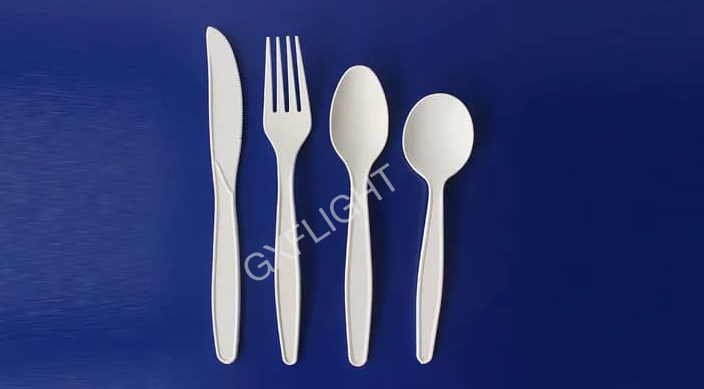
Understanding what corn starch cutlery is and what material and performance characteristics make it suitable for high-end sustainable cutlery applications helps procurement teams and brand teams evaluate according to the specific requirements of their dining service scenarios.
Corn starch cutlery is biobased disposable cutlery produced primarily from corn starch material. Corn starch material can be processed and molded into forks, spoons, knives, sporks, and complete cutlery sets, with the dimensional precision, surface smoothness, and structural strength required for high-end dining service applications. Different from certain natural fiber alternatives—such as wooden cutlery with rougher surface textures or bagasse cutlery with limited shape precision—corn starch material can achieve tighter dimensional tolerances and smoother surface finishes through molding, supporting the quality tactile experience required by high-end dining scenarios.
The biobased source of corn starch material supports the sustainable positioning of eco-friendly cutlery for high-end brands. By reducing reliance on traditional petroleum-based plastics, corn starch cutlery helps brands demonstrate real material transformation in their disposable cutlery procurement—this transformation can be communicated to customers, included in ESG documentation, and verified through food contact safety tests.
| Product Type | Main Application | Branding Opportunity |
|---|---|---|
| Corn Starch Fork | Salad, Main Course, Dessert | Handle Logo Embossing, Custom Color |
| Corn Starch Spoon | Soups, Rice Dishes, Desserts | Ergonomic Spoon Head Design, Custom Color |
| Corn Starch Knife | Airline Meals, Catering, Takeaway | High-End Grip Design, Logo Embossing |
| Corn Starch Spork | Compact Meal Service, Delivery | Space-Saving Branded Design |
| Individual Packaged Cutlery Set | Airlines, Hotels, Food Delivery | Custom Packaging, Napkins, Toothpicks, Condiment Packs |
| Retail Packaging | Supermarkets, Distributors | Branded Outer Packaging with Sustainability Information |
For buyers looking for OEM biobased cutlery manufacturers, Gxflight supports a full range of product types and has customization capabilities in color, logo, handle design, packaging, and set combination, enabling buyers to develop complete branded cutlery solutions rather than sourcing individual generic products.
The customization capabilities of corn starch cutlery are key to distinguishing it from generic eco-friendly alternatives and making it a brand experience tool. Understanding how each custom element contributes to brand experience value and which practical factors influence each element helps brand and procurement teams design specifications for custom corn starch cutlery that convey the intended brand message.
Custom Color is the most intuitive customization element and the direct connection between cutlery and brand visual identity. Corn starch material can be produced in multiple colors and matched to brand color specifications—airlines can match fuselage or brand visual colors, hotels can match interior design palettes, dining brands can match packaging and service design. The color of cutlery at the dining moment immediately establishes a visual connection with the brand, something ordinary beige or natural fiber color cutlery cannot provide. Buyers should confirm custom colors use food-safe coloring agents and request food contact safety documentation for specific color formulations.
Embossed Logo is the most clearly visible customization element making brand sustainability commitments apparent at the dining moment. A logo embossed on the cutlery handle conveys that the brand has made an intentional and designed choice in eco-friendly cutlery, not simply purchased the lowest-cost alternative. Embossing requires logo designs to be simplified for clear presentation during molding—overly fine details and overly small text may not be clearly replicated—so buyers should request embossing samples before mass production to confirm logo presentation meets expectations.
Ergonomic Handle Design is a customization element transmitting high-end quality through tactile experience rather than visual identification. Whether the handle comfortably fits the palm, whether it has the appropriate weight and balance for the type of dining, and whether the surface touch feels refined rather than rough or cheap plastic-like, all contribute to a positive physical experience, reinforcing the brand's high-end service positioning. For airline catering applications, handle length and balance are especially important design considerations due to use within limited tray space.
Individual Packaging and Set Packaging extend the brand experience from the dining moment to the moment of opening the package. Custom packaging design—using brand colors, logos, and sustainability information—creates a small but meaningful brand interaction before the meal. The packaging material itself also conveys brand value: kraft paper packaging communicates a natural and sustainable positioning, custom printed paper packaging communicates a focus on high-end design, sealed hygienic packaging communicates food safety care. Set combinations—fork, knife, spoon, napkin, toothpick, salt and pepper pack or wet wipe—can be configured according to specific service formats and meal types.
The most effective custom corn starch cutlery projects treat the four customization dimensions as a coordinated brand communication system rather than independent product specifications. Color connects cutlery to brand visual identity. Embossed logos make sustainability commitments clearly visible. Ergonomic handles transmit quality through touch. Branded packaging creates a service ritual before dining begins, reinforcing high-end positioning. Together, they transform a functional disposable item into branded eco-friendly cutlery, actively participating in customer experience design.
Choosing eco-friendly cutlery materials for high-end sustainable cutlery projects requires evaluating the customization capabilities, dining experience quality, sustainability credentials, and practical performance of different material options, and understanding where corn starch cutlery offers the strongest combination of brand experience value and functional performance.
Corn Starch Cutlery offers the strongest combination of customization capabilities, surface quality, and brand experience potential for high-end dining service applications. The moldability of corn starch material allows precise shape control, smooth surface finishes, and clear logo embossing, which are difficult for natural fiber alternatives to match. Custom color options allow direct matching to brand colors. Biobased material sources support sustainable positioning while avoiding regulatory risks associated with traditional plastics. Buyers mainly need to confirm heat resistance for specific applications and verify food contact safety documentation for custom color formulations.
Wooden Cutlery provides a natural, rustic aesthetic suitable for certain brand positioning—such as farm-to-table restaurants, outdoor events, and natural food brands. Its limitations in high-end brand customization are clear: natural wood grain surfaces limit color customization options, logo embossing precision is less than molded materials, and the rough texture of some wooden cutlery may not align with high-end dining expectations.
Bamboo Cutlery offers stronger, higher-end natural material positioning compared to wooden cutlery, with better surface consistency and more refined appearance. Its price is usually higher than corn starch alternatives and requires careful source verification. Customization options are fewer than corn starch molded products.
PLA Cutlery is a plant-based plastic alternative with good surface finishes and certain customization capabilities, but its heat resistance is usually limited—often below 50°C—which limits its use in hot food service scenarios. It is more suitable for cold and room temperature applications.
Bagasse Cutlery can use the same bagasse fiber material as bagasse plates and food containers, creating a consistent material story for complete cutlery sets. Its shape precision and surface finish are usually not as refined as corn starch molded cutlery, potentially affecting high-end brand positioning.
| Material Option | Customization Capability | Surface Quality | Heat Resistance | High-End Brand Adaptability |
|---|---|---|---|---|
| Corn Starch Cutlery | High—Color, Logo, Handle Shape | Smooth, Moldable | Medium—Confirm by SKU | Strong |
| Wooden Cutlery | Limited—Natural wood grain limits color | Variable texture | Good | Suitable for rustic positioning |
| Bamboo Cutlery | Medium | Good | Good | High-end natural positioning |
| PLA Cutlery | Medium | Good | Low—Typically below 50°C | Eco-friendly positioning |
| Bagasse Cutlery | Medium | Variable | Medium | Suitable for consistency with bagasse cutlery sets |
Custom corn starch cutlery creates the highest brand experience value in applications where the dining moment is an important customer touchpoint, and brand sustainability commitments are a commercial differentiation factor: airline business class and high-end economy class catering, where dining service is a key part of passenger experience; hotel and resort dining, reinforcing property service positioning through branded cutlery; corporate event catering, where customer sustainability credentials need to be visible; high-end takeaway and food delivery brands, where the unboxing experience is part of the product experience; cruise dining, requiring consistent branded service across multiple meal services; and retail cutlery packaging, where outer packaging design conveys the brand's sustainability story to end consumers.

Developing and procuring custom corn starch cutlery for high-end sustainable cutlery projects requires systematic pre-procurement planning and storage and handling practices to protect product quality and brand consistency in the supply chain.
Before placing large orders for custom corn starch cutlery, buyers should confirm the following:
Clarify complete cutlery set requirements—fork, spoon, knife, spork, or complete set—and confirm size and weight specifications for each product based on meal type and service format
Confirm custom color requirements and request food contact safety documentation for specific color formulations—do not assume all color options have the same food contact safety credentials
Confirm logo embossing feasibility—request logo design embossing samples before mass production to verify clear presentation of the logo at handle scale
Confirm ergonomic handle design requirements—clarify handle length, grip contour, and weight balance based on specific meal types and service scenarios
Confirm individual packaging requirements—packaging material, packaging design, and set combination—and verify packaging material aligns with brand sustainability policy
Confirm heat resistance specifications for specific applications—hot food service, microwave use, or room temperature use only—and verify selected products meet that requirement
Confirm target market food contact safety documentation requirements—FDA reports, SGS tests, or other market-specific certifications
Confirm sustainability statement documentation—biobased content certification, compostability certification if applicable, and PFAS-free declaration required by target market or customers
Confirm minimum order quantities for custom molds and custom colors—custom molding and color matching typically require a different minimum order commitment than standard product orders
Request samples for dining experience testing before committing to mass production—test handle comfort, structural strength under meal conditions, and logo embossing quality
Store cartons in a dry, cool, well-ventilated warehouse to avoid direct sunlight and high humidity—corn starch material may be affected by moisture and extreme temperatures during storage
Keep products in individual packaging or carton packaging before use to maintain hygiene and prevent contamination
Avoid overloading when stacking cartons—follow supplier-recommended stacking limits to prevent compression damage to cutlery
Confirm heat use limits for specific product SKUs before serving high-temperature food—do not assume uniform heat resistance across different corn starch cutlery products
Adopt first-in, first-out inventory management to ensure older batches are delivered for use before newer batches
Keep batch records and product documentation for each custom order—color matching, logo embossing specifications, and food contact safety reports should be retained for quality audits
Avoid mixing custom products from different production batches if color consistency is critical—request color consistency standards from suppliers before bulk ordering and confirm batch-to-batch color matching capability
Train service teams to correctly communicate the sustainability story of custom cutlery—the brand investment in custom eco-friendly cutlery can only be fully realized when service personnel can explain its sustainability credentials to customers
Eco-friendly cutlery no longer has to look ordinary, feel flimsy, or fail to convey the brand message of choosing it. With the right customization—matching brand identity with custom colors, making sustainability commitments visible with embossed logos, transmitting quality through touch with ergonomic handles, and creating a service ritual with branded packaging—corn starch cutlery can become a high-end sustainable cutlery asset, actively enhancing customer experience, not just replacing plastic.
For airlines, hotels, event caterers, food delivery platforms, and high-end takeaway brands that have already made sustainability commitments and want these commitments to be visible and tangible at the dining moment, custom corn starch cutlery from experienced OEM biobased cutlery manufacturers can provide the design capability, production consistency, and food contact safety documentation required for high-end brand projects. Gxflight supports global B2B customers in developing custom cutlery—from custom color matching and logo embossing to complete branded cutlery set packaging—providing the production capabilities and technical support needed for high-end sustainable cutlery projects.
Feel free to contact Gxflight to discuss your cutlery design needs, logo embossing specifications, custom color preferences, packaging formats, food contact safety documentation requirements, and bulk order planning. The Gxflight team can help you develop branded eco-friendly cutlery that aligns with brand image, service standards, and sustainability commitments, turning each meal service into a visible expression of brand value.
Q1: What is corn starch cutlery? How does it differ from traditional plastic cutlery?
Corn starch cutlery is biobased disposable cutlery made from corn starch material, reducing reliance on petroleum-based plastics. It can be molded into forks, spoons, knives, and sporks with smooth surfaces and precise shapes, supporting customization options—including custom colors, embossed logos, and ergonomic handle designs. Traditional plastic cutlery can also offer similar molding capabilities, but corn starch cutlery has a biobased material source supporting sustainable positioning.
Q2: Can corn starch cutlery be customized with brand logos and specified colors?
Yes. Corn starch cutlery can be embossed with logos on handles, customized in color according to brand specifications, designed with ergonomic handle shapes, and branded in individual packaging and set packaging. Custom molds and color matching typically have minimum order quantity requirements—buyers should confirm MOQ and request samples before mass production.
Q3: Is corn starch cutlery suitable for hot food service in airline and hotel catering?
Many corn starch cutlery products are suitable for hot food service, but heat resistance varies with product design and formulation. Buyers should confirm the heat resistance specifications of the specific product SKU being ordered and verify it meets the temperature requirements of the target application before bulk purchasing.
Q4: What should buyers check before purchasing custom corn starch cutlery?
Buyers should check if cutlery strength and size are suitable for meal types, if it meets the heat resistance required by service temperature, if target market food contact safety documents are complete, if custom colors have food safety credentials, quality of logo embossing on samples, if packaging materials comply with sustainability policies, minimum order quantities for custom production, and if the supplier can control color consistency for bulk orders.
Q5: Which industries are most suitable for using branded eco-friendly cutlery made from corn starch?
Airlines, hotels, resorts, corporate event caterers, high-end takeaway brands, food delivery platforms, cruise companies, and retail cutlery distributors benefit the most—especially in scenarios where the dining moment is an important customer touchpoint, and brand sustainability commitments are a commercial differentiation factor, needing to be visible and tangible at customer interaction points.