

By 2026, the decision-making process for purchasing disposable dining packaging has long surpassed simple cost comparison. For restaurant brands, airlines, catering suppliers, supermarkets, and packaging distributors operating in the international market, the choice of disposable tableware now carries multiple impacts in terms of regulation, law, and reputation, potentially determining market access, customer audit outcomes, and the credibility of ESG reports. Restrictions on disposable plastics, PFAS "forever chemicals" regulations, compostable certification requirements, and food contact safety standards are converging into a new compliance environment, making traditional petroleum-based disposable packaging an increasingly risky procurement choice.
Sugarcane Bagasse Products—disposable dining items molded from the fibrous agricultural byproduct left after sugarcane juice extraction—offer a practical and commercially scalable alternative. As sugarcane tableware, sugarcane bagasse bowls, plates, cups, trays, food containers, soup bowls, and cutlery can replace foam and plastic disposables across a wide range of dining applications, supporting compostable claims, PFAS-free procurement, and circular economy procurement narratives. For buyers dealing with 2026 plastic ban compliance, PFAS restrictions, and biodegradable food packaging regulations in the EU, North America, and Southeast Asian markets, certified compostable tableware made from sugarcane bagasse provides a compliance path without sacrificing dining performance.
Gxflight offers sugarcane bagasse bowls, plates, cups, food containers, trays, sauce cups, and cutlery for food service and airline catering applications, with product features including water and oil resistance, heat and cold resistance, compatibility with microwave ovens and refrigerators, and support for FDA testing and SGS certification for food contact tests. This guide is aimed at procurement and compliance teams, systematically explaining why regulatory pressure is making traditional disposable plastics unsustainable by 2026; what sugarcane bagasse products are, and why sugarcane bagasse is a truly circular material; how certified compostable tableware is produced, and what certifications buyers should require; how sugarcane bagasse compares with plastic, foam, PLA, and paper alternatives; and what procurement, storage, and handling practices can protect compliance value in the supply chain. This article will also discuss secondary keywords related to decisions—PFAS-free sugarcane bagasse products, certified compostable tableware, 2026 plastic ban compliance, and biodegradable food packaging regulations.
The regulatory pressure reshaping disposable dining packaging procurement in 2026 does not originate from a single jurisdiction or regulatory tool. It is the overlay of plastic restriction policies, PFAS chemical regulations, compostable certification requirements, and corporate ESG audit standards, with these requirements tightening simultaneously in major markets served by global dining buyers.
EU Packaging Regulations are the most comprehensive regulatory development affecting procurement for market access of dining packaging in the EU. The EU Packaging and Packaging Waste Regulation has taken effect in 2025 and is generally applicable from August 12, 2026. This regulation includes rules for minimizing substances of concern in packaging and restrictions on PFAS exceeding specific thresholds in food contact packaging—meaning packaging products exceeding regulatory thresholds for PFAS, regardless of other performance, will face market access restrictions in the EU. For buyers supplying the EU dining market, PFAS-free sugarcane bagasse products are no longer just a sustainable preference but a legal requirement.
North American Regulatory Actions add a second layer of compliance pressure. Canada's Single-use Plastics Prohibition Regulation bans the manufacture, import, and sale of certain categories of single-use plastic dining items. In the US, the FDA announced that PFAS-containing oil-resistant substances used in paper and paperboard food packaging are no longer sold in the US market following industry phase-out actions—accelerating buyer interest in PFAS-free food packaging alternatives, including sugarcane bagasse products with fluoride-free oil resistance systems.
Southeast Asian Policy Trends are creating additional market pressure for plastic ban compliance. Malaysia's roadmap aims to achieve zero single-use plastics by 2030, and Thailand is advancing plastic waste management actions targeting plastic bags and foam food containers. For restaurant brands and packaging distributors serving the Southeast Asian market, the regulatory direction is already clear—procuring certified compostable tableware now can enable buyers to stay ahead of the compliance curve rather than catching up passively.
Corporate ESG Audit Requirements constitute the fourth layer of pressure, operating independently of specific regulatory mandates. Large restaurant brands, airline catering operators, and retail chains are increasingly demanding their packaging suppliers demonstrate compliance with green procurement policies, provide documentation of recycled or renewable material content, and confirm the absence of PFAS and other substances of concern—requirements that traditional plastic and foam packaging struggle to meet.
Understanding what sugarcane bagasse products are, and why sugarcane bagasse possesses stronger circular economy attributes than most sustainable packaging alternatives, helps buyers clearly communicate the sustainable value of their packaging choices to customers, auditors, and ESG report stakeholders.
Sugarcane bagasse products are disposable dining items made from sugarcane bagasse—bagasse is the fibrous residue left after sugarcane juice is extracted during sugar production. This fibrous byproduct was traditionally burned as low-value fuel or disposed of as agricultural waste. Molding pulp manufacturing technology transforms this agricultural residue into durable, food contact-safe tableware—including bowls, plates, trays, cups, clamshell containers, food containers, lids, and cutlery—that can replace petroleum-based plastics and polystyrene foam in a wide range of dining applications.
The circular economy attributes of sugarcane bagasse are stronger than most sustainable packaging alternatives for clear and commercially meaningful reasons: sugarcane bagasse is not grown for the purpose of packaging production. It is a byproduct of the sugar-making process—whether used for packaging or not, this material will exist. This means using sugarcane bagasse for tableware does not require additional agricultural land, water resources, or agricultural inputs beyond what is already needed for sugar production. This packaging material is true waste stream reuse, not crops grown specifically for packaging purposes.
This distinction is important for buyers needing to explain their sustainable packaging claims to ESG auditors, green building certification evaluators, and sustainability-conscious customers. Packaging materials made from agricultural waste that might otherwise be burned or discarded have a more compelling circular economy story than materials requiring dedicated agricultural production.
Gxflight's sugarcane tableware uses sugarcane bagasse to replace petroleum-based plastics or foam materials, claiming that its sugarcane bagasse tableware can degrade into carbon dioxide and water within 30 to 90 days under suitable conditions—with appropriate third-party certification support, this compostable performance can support certified compostable tableware claims.
If sugarcane bagasse products cannot perform adequately in real dining scenarios, their circular economy value holds no commercial significance. Gxflight's sugarcane tableware offers water and oil resistance, cold and heat resistance, and is suitable for microwave ovens, ovens, and refrigerators—standard bowls, plates, and cups can withstand temperatures up to 120°C. This combination of performance makes sugarcane bagasse products suitable for hot food takeout, airline catering, cafeteria service, and various dining scenarios currently heavily reliant on traditional plastic and foam disposables.
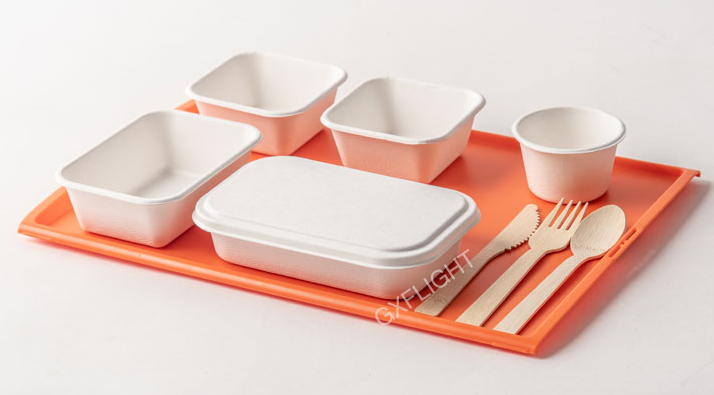
Understanding the production process behind certified compostable tableware, and what quality controls and certifications distinguish compliant products from uncertified ones, helps buyers assess supplier capabilities and clarify the documentation needed for target markets.
Sugarcane Bagasse Fiber Collection is the first step in the production process. After sugarcane juice extraction, the remaining fibrous material is collected as raw material for pulp production. The quality and consistency of sugarcane bagasse raw material at this stage affects the quality and performance stability of the finished tableware.
Pulp Preparation transforms sugarcane bagasse fiber into uniform pulp suitable for molding. Gxflight states that biodegradable sugarcane bagasse tableware is made through sugarcane pulp molding and hot press forming—a manufacturing process using high-pressure molds and heat to shape the pulp into desired tableware forms.
Food-grade Additive Control is the critical production step determining whether the final product can claim to be PFAS-free. Food-grade additives are used to enhance water and oil resistance—these functional characteristics enable sugarcane bagasse tableware to hold hot, oily, and watery foods without leakage or softening. Gxflight states its fluoride-free series uses fluoride-free oil resistance agents and meets BPI certification standards—this is a key distinction for buyers targeting the EU market and those needing to provide PFAS-free claims to customers.
Sterilization and Quality Inspection ensure food contact safety as the final production control. Production controls described by Gxflight include ultrasonic pulping, high-temperature UV sterilization, vacuum workshop operations, and dual mechanical and manual inspection—these process controls support the food contact safety documentation needed for target markets.
Certification systems for compostable tableware vary depending on the target market. Before placing large orders, buyers should confirm which certifications are needed for their specific applications and markets:
FDA Food Contact Test Report: Suitable for US market access and buyers requiring FDA compliance documentation
SGS Test Report: Independent third-party verification for food contact safety and material composition
BPI Certification: Suitable for the US market, BPI (Biodegradable Products Institute) certification confirms products meet ASTM D6400 or ASTM D6868 compostability standards
OK Compost or EN 13432 Certification: Suitable for the EU market, confirming products meet European industrial compostability standards
PFAS-free or Fluoride-free Declaration: Suitable for market access under EU PPWR PFAS restrictions and buyers with internal PFAS-free procurement policies
Heavy Metal Test Report: Confirming products meet food contact safety requirements for heavy metal content
Compostability Test Report: Confirming product degradation performance under industrial composting conditions
Gxflight states that its sugarcane bagasse food containers, plates, cups, and bowls have food contact safety and have passed FDA testing and SGS certification, with some products having ASTM D6868 or BPI certification depending on product requirements.
Choosing disposable dining packaging to comply with the 2026 plastic ban requires evaluating the regulatory compliance, sustainability credentials, dining performance, and total cost of ownership of available materials, and understanding where sugarcane bagasse products offer the strongest combination of compliance value and practical performance.
Sugarcane Bagasse Products offer buyers the strongest combination for addressing 2026 plastic ban compliance: regulatory compliance credentials, a true circular economy material story, compostable certification pathway, and dining performance. Its agricultural waste source, availability of PFAS-free options, compostable certification pathway, and food contact safety documentation make it the most universally compliant solution for global buyers to replace traditional plastics and foam in a wide range of dining applications. Its main limitation is that realizing composting benefits requires industrial composting infrastructure—in markets where industrial composting is not widespread, end-of-life benefits may be limited.
Plastic Tableware faces increasing restrictions in major markets, presenting growing regulatory, ESG, and reputational risks for buyers in regulated markets. While still cost-competitive in markets without plastic restrictions, regulatory trends in the EU, North America, and Southeast Asia make it a high-risk choice for long-term procurement.
Foam Food Containers are among the most commonly targeted product categories in global plastic and packaging restriction regulations. Their non-recyclable, non-compostable, and petroleum-based material attributes make them the most susceptible to regulatory restrictions among traditional packaging forms.
Paper Tableware is a familiar and widely used alternative, but requires careful evaluation of coating materials—many paper food containers use PFAS-containing oil-resistant coatings, which are currently restricted in the EU and phased out in the US market. Paper tableware with fluoride-free coatings can be compliant, but buyers should confirm specific coating systems before assuming compliance.
PLA Tableware is a plant-based plastic alternative with compostable credentials, but its degradation requires industrial composting infrastructure; compared to sugarcane bagasse products, its heat resistance is limited—typically unsuitable for hot food applications above approximately 50°C unless using special formulations.
Bamboo and Wooden Tableware offer renewable material positioning in tableware applications but require food contact testing and source verification, with costs typically higher than sugarcane bagasse alternatives.
| Material Options | Regulatory Compliance | Compostability | Heat Resistance | PFAS Risk |
|---|---|---|---|---|
| Sugarcane Bagasse Products | Strong—Can Replace Plastic and Foam | Certified Industrial Compostable | Up to 120°C | Low—Fluoride-free Options Available |
| Plastic Tableware | Increasing Restrictions | Not Compostable | High | Low Material Risk, High Regulatory Risk |
| Foam Containers | Frequently Banned | Not Compostable | Medium | Low Material Risk, High Regulatory Risk |
| Paper Tableware | Usually Compliant | Depends on Coating | Medium | Check Coating—Non-Fluoride Has PFAS Risk |
| PLA Tableware | Usually Compliant | Industrially Compostable | Low—Usually Below 50°C | Low |
| Bamboo and Wooden Tableware | Usually Compliant | Biodegradable | Medium | Low |
Sugarcane bagasse products have the most value in applications requiring simultaneous compliance with plastic bans, PFAS-free credentials, compostable certification, and dining performance: aviation and onboard catering, where sustainability credentials are both brand and regulatory requirements; restaurant and takeout chains operating in plastic restriction markets; hotel and resort dining operations with green certification commitments; corporate cafeterias executing ESG procurement policies; school and university dining programs with sustainability requirements; supermarket deli and ready-to-eat food counters; event catering operations; food delivery platforms committed to sustainable packaging; medical dining services with food contact safety requirements; and export packaging distributors serving multiple regulated markets.
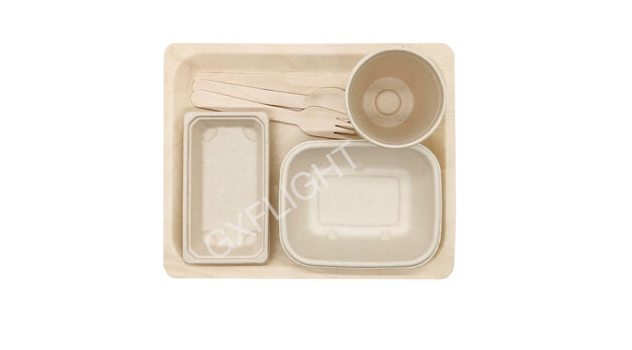
Procuring certified compostable tableware from sugarcane bagasse product suppliers for international dining applications requires systematically evaluating product compliance and supplier capabilities, and protecting product quality and compliance documentation integrity in the supply chain through storage and handling practices.
Before placing large orders for sugarcane bagasse products, buyers should confirm the following:
Confirm products are made from sugarcane bagasse pulp—not a mixture of bagasse and other fiber types, as mixed materials may affect compostable certification validity
Confirm PFAS-free or fluoride-free status and request written declaration—don't assume all sugarcane bagasse products use fluoride-free oil resistance systems
Request FDA food contact test report for US market applications and confirm the report covers the specific SKUs being ordered
Request SGS test report for independent third-party verification of food contact safety and material composition
Confirm BPI certification availability for US market compostable claims—and confirm the certification covers specific product SKUs, not just product categories
Confirm OK Compost or EN 13432 certification for EU market applications
Confirm maximum heat tolerance temperature for specific product SKUs—don't assume all sugarcane bagasse products from the supplier have the same heat resistance
Confirm microwave, oven, refrigerator, and freezer compatibility for specific applications
Confirm oil and water resistance performance for specific food types to be contained—oily, acidic, and high-moisture foods impose different requirements on oil resistance systems
Confirm lid compatibility—sugarcane bagasse, PET, PLA, or paper lid options—and verify lid materials also comply with target market packaging regulations
Confirm size, shape, logo printing, and export packaging customization options
Request samples for dining performance testing before committing to bulk order
Confirm compliance documentation—FDA report, SGS certificate, BPI or OK Compost certificate, PFAS-free declaration—can match each batch of goods for audit traceability
Store products in a dry, well-ventilated warehouse to avoid direct moisture exposure—sugarcane bagasse fiber products may absorb moisture in damp environments, affecting structural integrity before use
Keep cartons sealed before use to prevent dust contamination and moisture absorption
Avoid stacking beyond recommended carton limits to prevent compression or heavy pressure—compared to plastic alternatives, sugarcane bagasse tableware is more susceptible to compression damage
Confirm oven and microwave temperature limits for each specific product SKU before using in heated dining applications—don't assume different product types have uniform heat resistance
Separate compostable products from traditional plastic waste after use to enable compost processing—traditional plastic contamination of compostable waste streams reduces compost efficiency
Collaborate with local industrial composting partners where conditions permit to ensure compostable value is truly realized at end-of-life
Maintain certification documents, test reports, and batch records for each product SKU for customer audits and regulatory compliance
By 2026, the regulatory, ESG, and reputational risks of traditional disposable plastic and foam packaging have reached a level where actively procuring compliant alternatives becomes a commercial necessity, rather than just a sustainable vision.Sugarcane Bagasse Products—certified compostable tableware made from sugarcane agricultural waste—offer a practical, commercially scalable, and truly circular alternative, addressing plastic ban compliance, PFAS-free procurement requirements, compostable certification needs, and food contact safety documentation requirements.
For companies dealing with biodegradable food packaging regulations in the EU, North America, and Southeast Asian markets, certified sugarcane tableware from suppliers with FDA, SGS, BPI, and fluoride-free credentials provides the compliance foundation needed by procurement teams, ESG auditors, and sustainability-conscious customers. Gxflight offers sugarcane bagasse bowls, plates, cups, food containers, trays, sauce cups, and cutlery for food service and airline catering, with product features including water and oil resistance, heat and cold resistance, microwave and refrigerator compatibility, and comprehensive food contact testing support.
Feel free to contact Gxflight to discuss your target market requirements, needed certifications, PFAS-free documentation needs, food contact test standards, packaging form preferences, and bulk order plans. The Gxflight team can help you determine suitable sugarcane bagasse products and sugarcane tableware configurations based on specific compliance and dining performance requirements, and provide the certification documents needed for procurement and audit processes.
Q1: What Are Sugarcane Bagasse Products? What Are They Made Of?
Sugarcane bagasse products are disposable dining items—including bowls, plates, trays, cups, food containers, and cutlery—molded from sugarcane bagasse. Bagasse is the fibrous byproduct left after the sugarcane juice is extracted during sugar production. They replace petroleum-based plastics and foam disposables with compostable alternatives based on agricultural waste.
Q2: Are Sugarcane Bagasse Products PFAS-free?
Products can be PFAS-free when produced using fluoride-free oil resistance systems. Buyers should request a written PFAS-free or fluoride-free declaration for each specific product SKU and confirm that this declaration is supported by test documentation, rather than remaining at the general product category declaration level.
Q3: What Certifications Are Required for 2026 Plastic Ban Compliance?
Buyers should request the FDA food contact test report required for US market access, SGS test for independent verification, BPI certification for US compostable claims, OK Compost or EN 13432 for EU market access, PFAS-free declaration required for EU PPWR compliance, and heavy metal test report. Certification must cover the specific product SKUs being ordered.
Q4: Can Sugarcane Bagasse Tableware Hold Hot and Oily Foods?
Many sugarcane bagasse products are designed for hot, wet, and oily foods, with standard products having heat resistance up to 120°C. Specific performance depends on product design and oil resistance systems—buyers should validate heat resistance, oil resistance, and microwave compatibility for each specific SKU before placing bulk orders.
Q5: Why Is Sugarcane Bagasse Considered a Circular Economy Material?
Sugarcane bagasse is a byproduct of the sugar-making process—whether used for packaging or not, it will exist. Using it for tableware is repurposing agricultural waste that might otherwise be burned or discarded, without requiring additional agricultural land or inputs. This true waste stream reuse source gives sugarcane bagasse products stronger circular economy attributes than packaging materials made from dedicated crops.