

Aircraft service carts are an essential part of cabin operations on commercial passenger flights. They allow cabin crew to move meals, beverages, duty-free products, waste, and other supplies efficiently through the aircraft aisle without repeatedly returning to the galley. Although many carts may look similar at first glance, their internal layouts, capacities, materials, and intended uses can be quite different.
For airlines and aviation catering operators, choosing the right aircraft service carts is therefore not simply a matter of selecting a trolley with the appropriate dimensions. The cart needs to work with the aircraft's galley configuration, cabin layout, service procedures, storage arrangements, and operational requirements. Understanding the main types of carts can make it easier to determine which configurations are suitable for different stages of an in-flight service.
What Are the Main Types of Aircraft Service Carts Used on Passenger Flights?
Commercial aircraft commonly use several types of service carts, each designed around a particular cabin task. Meal and beverage carts are used during passenger service, while waste carts support collection after meals and other cabin activities. Galley carts and storage-oriented units are used to organize supplies and support preparation before and during service.
The exact cart configuration depends on the aircraft and airline. Narrow-body and wide-body aircraft can have different galley layouts, and airlines may also specify different cart arrangements according to route length, catering procedures, and cabin-service concepts.
| Cart Type | Primary Use | Typical Contents | Key Design Considerations |
|---|---|---|---|
| Meal Service Cart | Passenger meal distribution | Meal trays, packaged food, tableware | Storage capacity, handling, compatibility with galley equipment |
| Beverage Cart | Drink service | Bottled drinks, cans, cups, beverage accessories | Organization, accessibility, stability, cleaning |
| Waste Collection Cart | Cabin waste collection | Used meal trays, packaging, general cabin waste | Easy handling, hygiene, secure containment |
| Galley Cart | Galley preparation and storage | Food, beverages, service equipment, supplies | Aircraft galley compatibility and efficient storage |
| Storage Cart | Transporting or organizing supplies | Service items, amenities, catering supplies | Internal organization, accessibility, secure movement |
Some airlines may use a single cart configuration for several related tasks, while others prefer dedicated carts for different service stages. The decision depends on how the cabin crew operates and how the galley is organized rather than on the cart name alone.
How Do Meal and Beverage Service Carts Support In-Flight Catering?
Meal and beverage service is one of the most visible applications for aircraft service carts. During a typical cabin service, the cart provides a mobile work and storage platform that allows crew members to distribute food and drinks while minimizing unnecessary movement through the aircraft.
Meal carts need to accommodate the food and service items required for the particular catering operation. Depending on the airline's service model, this can include prepared meal trays, packaged foods, cutlery, napkins, condiments, and other passenger-service items. The internal arrangement needs to make frequently used items easy to access without making the cart difficult to handle.
Beverage carts have a somewhat different role. They need to organize drinks and related accessories so that cabin crew can serve passengers efficiently. Bottles, cans, cups, mixers, and other items may need separate storage areas, depending on the service configuration.
This is where airline food carts become particularly important. A well-designed airline food cart should not only provide sufficient storage but also make the workflow predictable. Crew members should be able to locate common service items quickly, move the cart through the aisle with control, and return it to the galley without unnecessary handling.
For airlines, the choice between different airline food carts should therefore be based on the actual catering workflow. A cart with a large nominal capacity is not necessarily more useful if its internal layout makes service slower or difficult to organize.
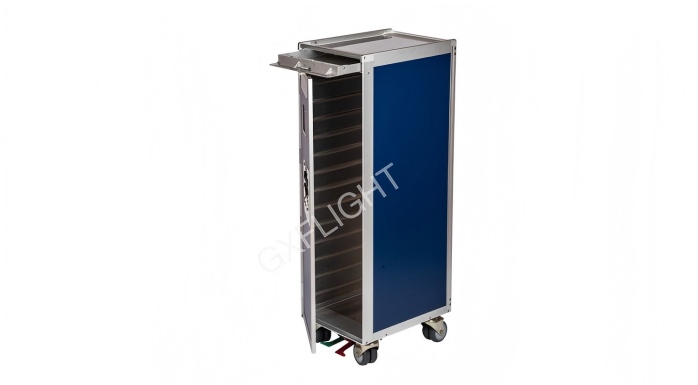
What Are Waste and Collection Carts Used for in Aircraft Cabins?
Waste collection is another important application of aircraft service carts. Once meals and beverages have been served, the same cabin that required organized distribution also needs an efficient way to collect used trays, packaging, cups, and other waste.
Waste carts are designed with this later stage of the service cycle in mind. Their internal configuration and access points should allow cabin crew to collect waste efficiently while keeping the contents contained during movement through the cabin.
Hygiene is particularly important for waste collection equipment. Surfaces should be practical to clean, and the cart should be designed to support the airline's established handling and sanitation procedures. Secure doors, covers, or other containment features may also be relevant depending on the cart design and application.
Operational efficiency matters here as well. A waste cart that is difficult to maneuver or requires repeated handling can add unnecessary work during a busy cabin turnaround. The best configuration is one that fits naturally into the airline's existing collection procedure while remaining compatible with the aircraft's galley and storage areas.
How Do Galley and Storage Carts Differ From Standard Service Carts?
Although galley carts and standard service carts may share similar external dimensions, their functions can be quite different. A standard service cart is primarily intended to support passenger-facing activities in the cabin, whereas a galley or storage cart may be designed around preparation, organization, or supply management.
Galley carts need to work within the limited space available in an aircraft galley. Their design therefore needs to consider how the cart is stored, accessed, and moved between the galley and cabin. Internal compartments can be configured around catering supplies or other equipment that needs to remain organized before service begins.
Storage carts can be used when airlines need to move supplies that are not directly involved in passenger meal distribution. Depending on the application, these may include service accessories, passenger amenities, catering supplies, or other cabin-service materials.
The distinction is useful when selecting aircraft service carts because a cart designed primarily for passenger service may not provide the organization or storage configuration required inside the galley. Evaluating the intended workflow first can prevent airlines from choosing a technically compatible cart that is operationally inconvenient.
Which Aircraft Service Carts Are Used for Different Cabin Service Needs?
Different cabin classes do not necessarily require completely different cart structures, but their service requirements can influence the preferred configuration. Economy-class service usually involves a high number of passengers and emphasizes efficient distribution, straightforward handling, and consistent turnaround procedures.
Business-class service may involve more varied meal presentations, additional tableware, or different beverage arrangements. In this environment, internal organization and accessibility can become more important because crew members may need to handle several types of service items during the same cabin service.
First-class service is often more individualized. Meals, beverages, tableware, and presentation items may be handled differently from a standard economy service. The cart itself may therefore need a more specialized internal configuration or may be used in combination with other galley equipment rather than functioning as a single all-purpose trolley.
For airlines operating multiple cabin classes, it is useful to consider the entire service process rather than selecting a cart separately for each cabin. The aircraft galley, storage locations, crew workflow, catering loading process, and cabin service sequence all interact with one another.
What Should Airlines Consider When Selecting Aircraft Service Carts?
Choosing aircraft service carts requires more than comparing dimensions and unit prices. The cart needs to fit the aircraft, but it also needs to fit the way the airline actually operates.
Aircraft compatibility should be established first. The cart dimensions, storage interface, doors, wheels, handles, and other structural features need to be appropriate for the intended aircraft and galley environment. If the airline operates more than one aircraft type, compatibility should be reviewed for each relevant configuration.
Material selection also affects long-term use. Airlines should consider weight, structural strength, surface durability, ease of cleaning, and resistance to the conditions associated with repeated cabin operations. The material specification should be evaluated together with the cart's intended service life and maintenance procedures.
Internal organization is equally important. For an airline food cart, the placement of shelves, compartments, drawers, or other storage features can directly affect how quickly cabin crew can access service items. A thoughtful internal layout can be more valuable operationally than simply increasing overall storage volume.
Mobility should also be tested in realistic conditions. The cart needs to move smoothly through the aircraft aisle and remain manageable when fully loaded. Wheel configuration, handles, braking or locking mechanisms, and overall balance can all influence handling.
Finally, airlines should consider customization and after-sales support. Different aircraft configurations may require different dimensions or internal arrangements, while airline branding may call for specific colors or finishing. A supplier that can accommodate these requirements can make fleet-wide procurement easier to manage.
For airlines comparing different aviation cabin solutions, reviewing the GXFLIGHT aviation product range in the context of the actual catering workflow can help clarify which type of cart is appropriate for a particular application. Rather than choosing a cart based only on its external appearance, procurement teams can compare its intended use, storage configuration, materials, and customization possibilities with the requirements of their aircraft and cabin service.
Once the aircraft type, cart dimensions, intended use, loading requirements, and preferred configuration have been established, those details can be discussed with experienced suppliers. This is especially important when an airline needs customized airline food carts or several cart configurations for different aircraft. Airlines can discuss their aircraft service cart requirements with GXFLIGHT when they are ready to review specifications, customization options, samples, or quotation requirements.
Conclusion
Commercial aviation uses several types of aircraft service carts because different stages of cabin operations require different storage and handling solutions. Meal and beverage carts support passenger service, waste carts handle collection, while galley and storage carts help organize supplies before and during the service process.
The right choice depends on the aircraft configuration, cabin-service workflow, catering requirements, storage environment, material specification, and expected operating conditions. For airlines, airline food carts and other service carts should be evaluated as part of the complete cabin-service system rather than as standalone pieces of equipment. A supplier that understands these operational requirements can also help develop configurations that are practical for the aircraft and consistent with the airline's service standards.
Frequently Asked Questions
1. What are aircraft service carts used for?
Aircraft service carts are used to transport and organize meals, beverages, waste, supplies, and other items during aircraft cabin operations.
2. What is an airline food cart?
An airline food cart is a service trolley designed to store and distribute meals, food trays, tableware, and related catering items during passenger service.
3. Are meal carts and beverage carts the same?
They can have similar structures, but their internal layouts may differ according to the food or beverage items they are designed to carry and serve.
4. What is the purpose of a waste cart on an aircraft?
A waste cart collects used meal trays, packaging, cups, and other cabin waste after passenger service while helping keep waste contained during handling.
5. Can aircraft service carts be customized?
Yes. Depending on the supplier and application, customization can include dimensions, internal compartments, materials, colors, branding, and other structural details.
6. What should airlines provide when sourcing aircraft service carts?
Useful information includes aircraft type, galley configuration, cart dimensions, intended use, loading requirements, estimated quantity, material preferences, and any customization requirements.