

In 2026, the global market for environmentally friendly disposable tableware continues to expand, accompanied by significantly intensified regulatory scrutiny. For airlines, hotels, restaurants, catering companies, and packaging distributors who are purchasing bamboo tableware and wooden tableware as alternatives to traditional plastic tableware, the procurement decision is no longer a simple choice of a product labeled "natural," "eco-friendly," or "bamboo fiber." The reason is straightforward and highly commercial: not all products sold under the name "bamboo tableware" are truly as advertised.
A considerable portion of the so-called "bamboo fiber" tableware in the global market is not purely bamboo products. These products are often plastic food contact composites—melamine-formaldehyde resin as the matrix, mixed with bamboo powder or other plant-based fillers, molded into tableware shapes, and marketed using bamboo's natural, eco-friendly image. The EU Commission's "Bamboo-zling" enforcement action specifically targets plastic food contact products containing bamboo powder and other unauthorized plant-based additives. Regulators point out that under EU Regulation 10/2011, these products may cause melamine and formaldehyde migration into food beyond safe limits. For buyers procuring bamboo tableware for commercial dining scenarios, this regulatory reality means: material verification, food contact test documents, and supplier transparency are not optional due diligence steps but necessary procurement requirements.
Gxflight provides wooden and bamboo tableware solutions for airline catering, hotels, takeout, dessert shops, camping, parties, and other commercial dining scenarios, focusing on natural, renewable, biodegradable materials, with support for brand customization, embossing, and color printing options. This guide is aimed at procurement and compliance teams, systematically explaining: why there is a significant food contact safety risk in the bamboo tableware market; what true bamboo tableware and wooden tableware are and how they differ from bamboo plastic composites; what compliance documents buyers must demand; how bamboo and wooden tableware compare to plastic, melamine, and bagasse alternatives; and which procurement and storage practices can protect food contact safety and compliance value in the supply chain. The article also discusses related keywords for decision-making—melamine-free bamboo tableware, safe bamboo fiber tableware, FDA-compliant bamboo products, and non-toxic commercial tableware.
Understanding why the procurement of bamboo tableware needs proactive food contact safety verification, rather than relying solely on product labels and marketing claims, requires first clarifying what many "bamboo tableware" products actually contain and what regulatory consequences purchasing non-compliant products can bring to commercial buyers.
The core food contact safety issue in the bamboo tableware market is the widespread use of melamine-formaldehyde resin as a binder for so-called bamboo fiber tableware. Melamine-formaldehyde resin is a thermoset plastic that can be mixed with bamboo powder, rice husks, or other plant-based fillers to form moldable composites. The products produced from this look and feel like natural bamboo tableware—featuring natural color, slightly textured surfaces, and a light touch—but they are essentially plastic food contact products, not natural bamboo products.
The food contact safety hazard of melamine-formaldehyde composites lies in the possibility that, under specific conditions, the resin may release melamine and formaldehyde into food. Especially when tableware contacts hot food, acidic food, or undergoes repeated washing resulting in gradual resin degradation, migration risk increases. The FDA has noted that melamine tableware should not be used in microwaves, as hot acidic foods may cause more melamine to migrate from the tableware into the food. The EU Commission's enforcement action also clearly found that plastic food contact materials made with bamboo powder and other unauthorized plant-based additives may cause melamine and formaldehyde migration to exceed the safe limits specified in EU Regulation 10/2011.
For commercial buyers—airlines, hotels, chain restaurants, catering companies, and distributors—the consequences of purchasing non-compliant bamboo plastic composite tableware extend far beyond immediate food contact safety issues. It can also lead to a series of real commercial risks:
Encountering import refusal at the border of the EU or other regulated markets;
Exposure of food contact safety document deficiencies during customer audits;
Damage to brand reputation due to inability to prove sustainability claims;
Legal liability for supplying food contact products that do not meet target market regulatory requirements;
Direct financial loss from unsellable inventory or forced recalls.
The safest procurement strategy is not to trust the "bamboo" or "eco-friendly" label on a product but to verify material composition, demand melamine-free and formaldehyde-free statements, confirm food contact test documents, and work with suppliers capable of providing batch-level traceability to meet commercial audit requirements.
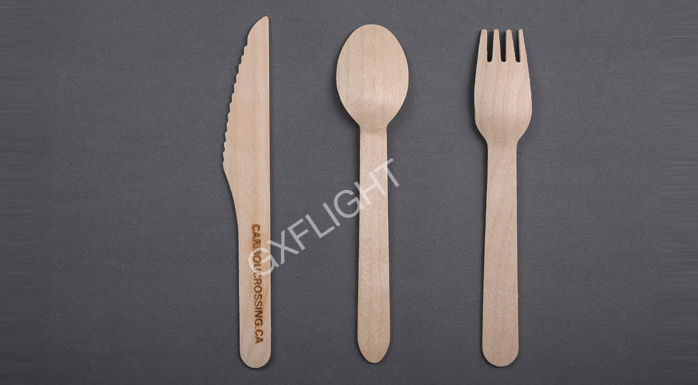
Understanding the difference between true natural bamboo tableware, safe bamboo fiber composite tableware, and bamboo powder melamine plastic composite tableware is the foundation for commercial dining buyers to establish food contact safety procurement strategies.
100% Natural Bamboo Tableware is directly made from natural bamboo, cut or molded into utensils such as bamboo forks, bamboo knives, bamboo spoons, stirring sticks, bamboo skewers, and serving tools. These products are processed from bamboo itself without adding plastic resins or chemical binders. Natural bamboo tableware is truly biodegradable and truly plastic-free, and its source is renewable—bamboo is one of the fastest-growing plants on Earth and can regenerate without replanting after harvesting. For buyers looking to procure verifiable natural materials, plastic-free and resin-free tableware, 100% natural bamboo products are the most convincing choice.
Natural Wooden Tableware is made from renewable wood, such as wood forks, wood knives, wood spoons, stirring sticks, and serving tools, made from food-grade wood without using plastic resin binders. Gxflight describes its wooden tableware as natural products sourced from abundant renewable resources and 100% biodegradable. Related products include wood knives, wood forks, wood spoons, and wooden stirring sticks, featuring lightweight, heat-resistant, healthy, eco-friendly, and portable characteristics, suitable for hotels, takeout, dessert shops, camping, parties, and other dining service scenarios.
Bamboo Fiber Composite Tableware is a category that requires careful evaluation. Some bamboo fiber composite products use food-safe binders and are manufactured according to food contact safety standards; if supported by corresponding test documents, they can be used in commercial dining scenarios. However, some products use melamine-formaldehyde resin as a binder—these products are essentially plastic food contact products, with the aforementioned migration risks, and may not meet EU or other market food contact regulatory requirements.
Melamine Bamboo Powder Plastic Tableware is the highest-risk category, i.e., plastic food contact products with bamboo powder added as filler in the melamine-formaldehyde resin matrix. These products are marketed using bamboo's natural image but are essentially plastic tableware and have food contact safety risks associated with melamine-formaldehyde composites.
| Product Type | Material Essence | Buyer Safety Assessment |
|---|---|---|
| 100% Natural Bamboo Tableware | Cut or molded from natural bamboo | Preferred for plastic-free, resin-free procurement |
| Natural Wooden Tableware | Made from renewable wood | Requires confirmation of food-grade surface treatment |
| Safe Bamboo Fiber Composite Tableware | Bamboo fiber with food-safe binder | Requires verification of binder composition and food contact testing |
| Melamine Bamboo Powder Plastic Tableware | Bamboo powder added to plastic resin | High regulatory risk—requires verification, non-compliance should be avoided |
| Coated Bamboo Products | Bamboo with surface coating | Requires confirmation of coating food contact safety |
The compliance document requirements for bamboo tableware and wooden tableware depend on the target market and product structure. For buyers needing to protect commercial and legal positions, the key is not what the supplier proactively offers but rather determining what documents the target market truly requires.
The EU Commission's "Bamboo-zling" enforcement action has established a clear regulatory stance: plastic food contact products containing bamboo powder and other unauthorized plant-based additives do not comply with EU Regulation 10/2011 regarding food contact plastic materials and products. This regulation requires that plastic food contact materials can only be manufactured using authorized substances, and bamboo powder and similar plant-based additives are not on the authorized substances list for plastic food contact materials.
For buyers distributing bamboo tableware in the EU market, this means that any product with a plastic resin matrix—including melamine-formaldehyde composites filled with bamboo powder—needs a strict compliance assessment. Products genuinely made from 100% natural bamboo or wood, and free of plastic resin binders, do not fall under the category of plastic food contact products as per the meaning of EU 10/2011, and thus are not subject to the same substance authorization requirements. However, buyers should still demand food contact safety documents to confirm natural material composition and absence of regulated substances.
In the US market, buyers should be cautious about claims like "FDA approved bamboo products." The FDA does not maintain a specific product approval list for bamboo tableware. More accurately, food contact materials must comply with FDA food contact regulations, and compliance is demonstrated through testing and documentation, not through a product-specific "FDA approval."
A safer procurement approach is to require suppliers to provide food contact test reports, material declarations, and related compliance documents, proving that the tableware meets FDA food contact requirements under intended use conditions—including whether it contacts hot food, acidic food, and if applicable, whether it will be reused.
For commercial buyers procuring bamboo tableware and wooden tableware for international dining services, it is recommended to demand the following documents:
Material composition declaration: confirm whether the product is natural bamboo, natural wood, or composite material; if composite, confirm binder composition;
Third-party test-supported melamine-free statement, rather than just supplier self-declaration;
Third-party test-supported formaldehyde-free statement;
If the product is sold as natural bamboo or wooden tableware, provide a plastic-free statement;
FDA food contact test report or compliance documents required for US market applications;
If the product contains any plastic components or coatings, provide EU 10/2011 related reports;
LFGB testing required for high-end retail market applications in Germany and the EU;
SGS, TÜV, or other recognized third-party laboratory test reports;
Heavy metal migration tests;
Migration tests for conditions involving hot and acidic foods;
Product specifications, confirming size, weight, and intended use conditions;
Batch traceability records for audit purposes.
Choosing environmentally friendly disposable tableware for commercial dining scenarios requires a comprehensive evaluation of the food contact safety, sustainability credentials, dining experience quality, and regulatory compliance of different material solutions, and understanding which scenarios bamboo and wooden tableware can provide the strongest combination of safety, sustainability, and practicality.
Bamboo Tableware—when confirmed as truly natural materials and supported by melamine-free and formaldehyde-free documents—offers commercial dining buyers a strong combination of natural material credentials, high-end dining experience, and sustainability positioning. Natural bamboo is genuinely renewable, biodegradable, and plastic-free; these credentials can be verified through material testing and confidently communicated to customers. Its primary procurement requirement is rigorous supplier verification to confirm the product is indeed natural bamboo rather than bamboo plastic composite.
Wooden Tableware offers comparable natural material attributes to bamboo tableware and has a more familiar, widely accepted natural material story. Gxflight's wooden tableware features lightweight, heat-resistant, healthy, eco-friendly, and portable characteristics, suitable for hotels, takeout, dessert shops, camping, parties, and other dining service scenarios. Buyers should confirm the food-grade surface treatment and anti-burr control of wooden tableware.
Plastic Tableware faces increasing restrictions in major markets and poses growing regulatory and reputational risks. Although it remains cost-competitive in markets without plastic restrictions, regulatory trends make it a high-risk long-term procurement choice for buyers in regulated markets.
Melamine Tableware can be a reusable option in certain dining scenarios but has clear food contact safety usage conditions—it should not be used in microwaves, and migration risk needs to be managed through appropriate usage conditions. For applications requiring natural material credentials, melamine is not suitable as a substitute for natural bamboo or wooden tableware.
Bagasse Tableware offers compostable alternatives for bowls, plates, and trays, and can form a complete eco-friendly tableware set with bamboo or wooden tableware. Buyers should verify that bagasse products are PFAS-free and confirm food contact certification.
PLA Tableware is a plant-based plastic alternative with compostable credentials but limited heat resistance—usually not suitable for hot food applications above about 50 degrees Celsius without special formulations.
| Material Options | Food Contact Safety | Sustainability Credentials | Best Suited Applications |
|---|---|---|---|
| Natural Bamboo Tableware | Strong performance when verified melamine-free | Renewable, biodegradable, plastic-free | High-end eco-friendly dining, airline meals, catering |
| Natural Wooden Tableware | Strong performance with food-grade treatment | Renewable, biodegradable, plastic-free | Airlines, takeout, desserts, camping, catering |
| Plastic Tableware | Mature but increasingly restricted | Low | Traditional low-cost applications in unrestricted markets |
| Melamine Tableware | Requires usage condition management | Low | Reusable dining scenarios where heating conditions are controllable |
| Bagasse Tableware | Strong performance when verified PFAS-free | Compostable, reuse of agricultural waste | Bowls, plates, trays, takeout packaging |
| PLA Tableware | Usually compliant | Plant-based, compostable | Cold food and ambient temperature applications |
Natural bamboo tableware and wooden tableware are best suited for applications that simultaneously require natural material credentials, food contact safety documents, and high-end dining experiences:
Airline and onboard catering: sustainability credentials are both a brand need and a regulatory requirement;
Hotel and resort dining: natural tableware can enhance the property's eco-friendly positioning;
Restaurants and takeout chains in markets with plastic restrictions;
Event catering: natural aesthetics can support the sustainability theme of the event;
Corporate dining projects adopting ESG procurement policies;
Outdoor and camping dining services: lightweight, biodegradable tableware offers practical use value;
Retail eco-friendly tableware sets: natural material stories are an important driver of consumer purchase decisions.
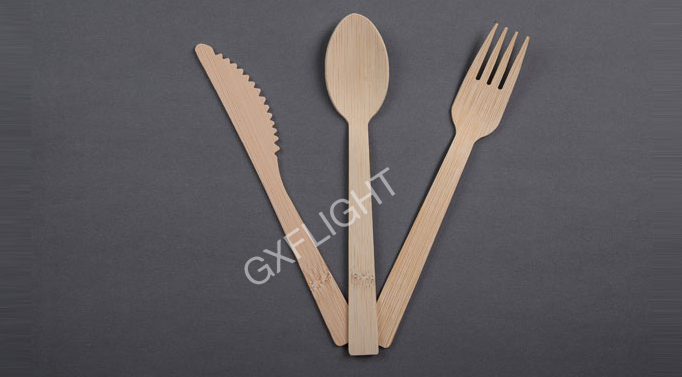
For commercial dining applications, purchasing safe bamboo tableware and wooden tableware requires systematically verifying material composition and compliance documents before procurement, and protecting product quality and food contact safety in the supply chain through proper storage and handling practices.
Before placing large orders for bamboo or wooden tableware, buyers should confirm the following:
Confirm whether the product is 100% natural bamboo, 100% natural wood, or composite material; if composite, confirm binder composition and whether it is melamine-formaldehyde or food-safe alternative;
Demand third-party laboratory test-supported melamine-free statement, rather than just accepting supplier self-declaration;
Demand third-party laboratory test-supported formaldehyde-free statement;
If the product is sold as natural bamboo or wooden tableware, demand plastic-free statement;
Confirm target market food contact test documents: FDA-related documents required for US market applications; if the product contains plastic components or coatings, provide EU 10/2011 related report; LFGB testing required for German and EU high-end retail applications;
Demand SGS, TÜV, or other recognized third-party laboratory reports covering heavy metal migration and food contact safety;
Demand migration test results under hot food and acidic food conditions—especially important for products intended for hot meals or citrus, vinegar-based dressings, tomato sauces, etc.;
Confirm the heat resistance range of specific product SKUs—do not assume uniform heat resistance across different bamboo or wooden tableware products;
Confirm whether the product is suitable for microwave, oven, dishwasher, or freezing environments, and verify that food contact documents cover intended use conditions;
Confirm customization options—size, shape, logo branding, embossing, color printing—and verify that customization processes do not introduce food contact safety hazards;
Demand pre-production samples for food contact performance testing before bulk orders;
Confirm batch traceability records for audit purposes.
Store products in a dry, well-ventilated warehouse to avoid direct moisture exposure—natural bamboo and wood products may absorb moisture in humid environments, affecting structural integrity and surface quality;
Avoid prolonged exposure to direct sunlight to prevent fading and surface deterioration of natural bamboo and wood products;
Keep the carton sealed before use to prevent dust contamination and moisture absorption;
Avoid overheating during storage—do not place near heating equipment or in areas with excessively high ambient temperatures;
Do not exceed the intended temperature range of the product—confirm heat resistance limits for each specific product SKU before using in heated dining service applications;
Do not assume all bamboo or wooden tableware is suitable for microwave or dishwasher—compatibility with usage conditions must be verified for each specific product;
Keep food contact test reports, material declarations, and batch records for each product SKU for customer audits and regulatory compliance;
Adopt first-in-first-out inventory management to ensure that old batch inventory is delivered before new batch use;
Train procurement and service teams to distinguish natural bamboo and wood tableware from bamboo plastic composites and correctly convey the food contact safety credentials of the products to customers and audit parties.
In 2026, the bamboo tableware market requires buyers to conduct proactive procurement due diligence, not just to read product labels or simply accept marketing claims. The EU and other major markets have established clear standards for regulatory scrutiny of bamboo plastic composite tableware: food contact safety must be proven through documents, not inferred from products described as sounding natural. For airlines, hotels, restaurants, catering companies, and distributors that need to pass customer audits, import inspections, and regulatory scrutiny, the strategy for procuring non-toxic commercial tableware must begin with material verification—confirming the product is indeed natural bamboo or wood, free of melamine, free of formaldehyde, and supported by trusted third-party food contact testing.
Gxflight provides wooden and bamboo tableware solutions for airline catering, hotels, takeout, dessert shops, camping, parties, and other commercial dining scenarios, focusing on natural, renewable, and biodegradable materials, with support for brand logos, embossing, and color printing options on wooden tableware handles. For buyers needing safe bamboo fiber tableware and wooden tableware and seeking documents supporting commercial audit requirements, Gxflight can offer products and compliance support that meet 2026 procurement standards.
Feel free to contact Gxflight to discuss your target market, food contact safety requirements, melamine-free and formaldehyde-free document needs, product size and form, packaging requirements, and custom branding options. The Gxflight team can assist you in selecting suitable bamboo tableware and wooden tableware solutions for specific applications and provide the compliance documents required for procurement and audit processes.
Q1: What is bamboo tableware? Is it necessarily suitable for food contact?
Bamboo tableware refers to utensils made from bamboo, such as forks, knives, spoons, stirring sticks, and serving tools. However, not all tableware labeled "bamboo" is safe. Some products are plastic composites containing bamboo powder and melamine-formaldehyde resin. Buyers should verify material composition before procurement and demand melamine-free and formaldehyde-free documents.
Q2: How can buyers identify melamine-free bamboo tableware?
Buyers should demand material composition declarations, third-party laboratory test-supported melamine-free statements, formaldehyde-free statements, and food contact test reports issued by recognized laboratories. Do not rely solely on supplier self-declarations; independent test documents are the reliable basis for verification.
Q3: What does FDA food contact compliance for bamboo products mean?
The FDA does not have a specific product approval list for bamboo tableware. Compliance should be demonstrated through food contact testing, i.e., the product meets FDA requirements under intended use conditions. Buyers should demand food contact test reports and material declarations, rather than accepting vague "FDA approved" claims without supporting documents.
Q4: What is the difference between bamboo tableware and wooden tableware?
Bamboo tableware is made from bamboo, and wooden tableware is made from wood. Both can serve as natural, renewable, biodegradable plastic alternatives when truly natural and properly tested. Buyers should confirm food-grade surface treatment, food contact safety documents, and intended use conditions for both materials.
Q5: What certifications or test documents should be required when procuring non-toxic commercial tableware?
It is recommended to demand FDA food contact test reports required for US market applications; if the product contains plastic components or coatings, provide EU 10/2011 related report; LFGB testing required for German and EU high-end retail applications; SGS or TÜV third-party laboratory reports; heavy metal migration tests; melamine-free statements; formaldehyde-free statements; and ensure all documents are supported by batch-level traceability records.